Data-Driven Policymaking: Using Visual Analytics to Guide Government Financial Decisions

By Broadleaf Services

In an era where data is the cornerstone of strategic decision-making, visual analytics is emerging as a critical tool for government policymakers. This blog post explores how visual analytics is revolutionizing the way financial decisions are made in the public sector, enhancing the understanding of complex financial data and the quality of decisions derived from it.


The Role of Visual Analytics in Policymaking

At the heart of effective policymaking is the ability to understand and interpret complex datasets. Visual analytics transform vast and complicated financial data into transparent, comprehensible visual formats, enabling policymakers to grasp intricate details quickly and accurately.

Although data visualization and visual analytics are used interchangeably, they are different.

According to computer science portal Geek for Geeks, data visualization is the graphical representation of information and data in a graphical format that provides an accessible way to understand trends, patterns in data, and outliers.

Visual analytics, on the other hand, is “the space where business meets data, art meets science, emotions meet technology, and creativity meets rationality,” according to Microsoft Design & Visualization Lead, Miranda Li.

Ms. Li states that in the world of big data, visualization is merely a vehicle. That’s why visual analytics uses analytics technology and adds visualizations to it to answer questions like: Who is my audience? Why should they care? Will I make their jobs easier and help them create more impact?

In other words, data visualization helps to answer “what?” questions about trends and problems. Visual analytics uses data analytics and visual representations to dig deeper, to answer “what?” but to also answer “why?”

Improving Understanding of Financial Data

One of the most significant challenges in government finance is the complexity and volume of data. Visual analytics breaks down these barriers, presenting data in a more intuitive and accessible way. This clarity is crucial for policymakers who must fully comprehend the financial implications of their decisions.

According to SAS, visual analytics can be used in public sector finance to:

  • Ensure good stewardship of revenue collection and disbursement activities
  • Understand the impact of different policy alternatives
  • Detect fraud, waste, and abuse to gain a realistic and holistic view of agency operations
  • Monitor credit conditions and financial data to improve risk management

Visual analytics uses machine learning and natural language explanations to find, visualize and narrate stories and insights that are easy to understand and explain.

Aiding Informed Decision Making

With the enhanced understanding that visual analytics provide, policymakers can make more informed decisions. This means policies are not just based on data but on a comprehensive understanding of what that data represents. It leads to more effective and targeted policy outcomes, benefiting public governance.

Take healthcare, for example. The Department of Health and Human Services’ (HHS) Agency for Healthcare Research and Quality (AHRQ) uses interactive data visualization tools to allow researchers, policymakers, healthcare leaders, and others to view visual depictions of healthcare trends.

These tools facilitate collaboration and industry transformation by providing customizable data resources on various topics such as COVID-19, health insurance coverage, and mental health. This data is then analyzed with specific queries that are visualized so policymakers can use evidence-based data to guide policy.

In 2023, visual analytics tools aided the HHS, through the AHRQ, to approve funding for nine grants of $1 million each up to 5 years to support multidisciplinary, Long COVID clinics across the country. Policymakers learned why the disease was affecting certain communities and geographies more so than others and was able to target the grants to reach people and communities with the greatest need.

Conclusion

Visual analytics in policymaking marks a significant shift towards more data-driven governance. This approach brings clarity and precision to the decision-making process and ensures that policies are grounded in a solid understanding of the financial landscape.

Ready to get started?

Are you in the government sector looking to leverage the power of visual analytics for better policymaking? Contact us today to explore how our expertise in visual analytics can transform your policy decision processes into more effective and data-driven practices.


Transforming Public Finance: The Power of Data Visualization in Government Budgeting and Spending

By Broadleaf Services

In today’s digital age, the public sector is under increasing pressure to be transparent, accountable, and efficient. One transformative tool that is making a significant impact in meeting these demands is data visualization. This blog post delves into how data visualization technologies revolutionize government budgeting and spending processes.

The Rise of Data Visualization in Public Finance

Data visualization is more than just a trend in the government sector; it’s a strategic tool reshaping how financial information is presented and understood. By converting complex budgetary data into visually engaging formats, stakeholders can more easily grasp key information, enabling better decision-making and enhanced public understanding.

Data visualization and analytic tools enable governments to gain insights into their operations. By using data visualization across various data sources, government agencies can monitor in real-time key performance indicators, budget figures, websites analytics, citizen feedback, and more. This enables organizations to make faster decisions, identify emerging trends, and respond swiftly to changing conditions.

The best visualizations help viewers understand not only the data, but also their implications. This can help agencies tell a story or connect with an audience in a way that helps to frame the data and create meaning. For most people, it’s much easier to identify trends and patterns by looking at a graph or map than having to sort through hundreds of rows in an excel spreadsheet. In fact, the human brain processes visuals 60,000 times faster than it does text.

Enhancing Transparency and Accountability

Transparency and accountability are vital in public finance. Data visualization tools make financial data more accessible and understandable to non-experts by cutting through the clutter and simplifying complex questions This open access to information empowers citizens, promotes trust, and fosters a culture of accountability.

The Government Finance Officers Association (GFOA) actively promotes the use of data visualization to help communicate capital improvement strategies and increase public engagement. The association believes public participation and stakeholder involvement during the planning, design, and construction of capital projects is extremely important. Because these projects can be complex, sharing information publicly with the aid of data visualization can give citizens a better understanding of what government agencies are trying to achieve. Data visualization is recommended for use across the process, including:

  • Developing a communications plan that explains capital needs, options, and strategies for the community.
  • Providing clear and consistent messages with accurate information about a project’s cost, duration, impact, and benefit.
  • Encouraging citizen engagement during the budgeting process to obtain a broad range of opinions and views from citizens to ensure the decision-making process is truly collaborative.
  • Making a genuine effort to engage citizens or risk increasing public cynicism and a poor perception of your government agency’s performance.

The United States Census Bureau uses data visualization maps to aggregate revenue, expenditure and employee data for state- and local-government budgets. Users can hover over each data element to receive additional information and customize the view by using drop-down menus and selected category buttons. Categories range from parks and recreation to public safety, and display in color-coded, interactive pie charts.

In Boston, the city originally launched CityScore as a way to inform the mayor and city managers about the overall health of the city at a moment’s notice by aggregating key performance metrics into one number. The project, which relies on data visualization dashboards, was eventually made public to provide a source of outward accountability and informs municipal spending based on metrics and results.

These examples illustrate how data visualization supports the principle of government transparency by aiding citizens to access and scrutinize the information and actions of their public officials more easily.

Improving Efficiency and Decision-Making

Efficiency in budgeting and spending is critical for government operations. Visual analytics help identify spending trends, forecast budget needs, and allocate resources more effectively. By providing a clear picture of financial data, these tools aid policymakers and financial officers in making informed decisions swiftly.

In Texas, the Dallas Office of Data Analytics and Business Intelligence (DBI) saved the city more than $15M in the first two years by eliminating the need for outside contractors to do analytics and business improvement work. The city’s chief data officer runs the DBI and reports directly to the city’s chief financial officer. The internal team oversaw 50 high-impact projects in year one with the launch of their open data portal. The portal displays data-visualization dashboards on topics such as crime analytics, employee diversity, domestic violence, and the status of municipal service requests from citizens.

Dallas is currently working on an extensive equity project that requires significant amounts of data to understand over 200 equity indicators. Data can show where services are being delivered, who is benefiting from different programs and how the city is addressing issues. This equity data work has been so successful that, for the first time ever, this data will inform the city’s next bond package; equity will be a measure to assess project inclusion in the bond.

But good data use in government isn’t just about getting information to residents. In fact, data is equally valuable for government internally. A new series of sweeping federal funding bills has allocated money for states and localities to invest in digital equity, infrastructure, and other areas. Making a strong case for the funding requires data.

Federal funding applications are less focused on a narrative and more focused on the ability of an entity to tell a story through numbers. Data visualization can go a long way in helping to craft a case that is both compelling and accurate with real-time, accurate data.

Take the next step

Integrating data visualization technologies in government budgeting and spending is not just a leap in digital transformation but a stride toward more responsible and responsive governance. These tools enhance how financial data is processed and understood and set new standards in public finance management.

To learn more about the latest data-visualization tools and techniques that can positively impact your government agency, contact us.

Additional sources:

https://questica.com/news/budget-transparency-begins-with-data-visualization/

https://www.govloop.com/training/april-5-how-to-explain-data-through-visualization-and-storytelling/

https://www.linkedin.com/advice/0/how-can-data-visualization-enhance-government-transparency-gj02c#:~:text=Data%20visualization%20is%20the%20art,%2C%20accountability%2C%20and%20citizen%20engagement.

Broadleaf Services Teams with Echelon Services and SPAARK to Deliver Strategic Data Analytics Support Services to a DoD Agency

Description of Work Performed: Broadleaf Services supports a broad spectrum of analytical and data visualization, data exploitation, management consulting, and support services necessary for implementing Artificial Intelligence/ Machine Learning (AI/ML) applications in the Contract Administration field. Specifically, Broadleaf Services applies expertise in professional consulting services to assist with the full range of business intelligence program/project management services necessary to implement a data strategy for DCMA, which is expected to evolve over the contract’s period of performance. These capabilities include a wide range of functional data management disciplines, including data exploitation and analysis, data visualization and dashboard strategy, application program and project management, and data management.

Broadleaf Services provides the COR with Monthly and Quarterly Progress Reports, covering all work completed during the reporting period and work planned for the subsequent reporting period. These reports also identify any problems that arose and give a description of how the problems were resolved. For any unresolved issues, Broadleaf Services provides an explanation including a plan and timeframe for resolution.  We monitor progression against the Performance Plan and report any deviations to prevent the need for escalation.

Background of DCMA Analytic Requirement: DCMA Chief Data Officer (CDO) requires additional resources and expertise to efficiently and effectively execute its responsibility for managing the Agency’s data resources and ensuring that DCMA complies with Federal law, Department of Defense (DOD) Directives and oversight, and internal policy and requirements.  Legal and statutory requirements include those specified in the Paperwork Reduction Act, Privacy Act, Federal Records Act, the Freedom of Information Act (FOIA), the Clinger-Cohen Act, and the Data Quality Act. Federal oversight requirements include policy and guidance documents issued by the Office of Management and Budget (OMB), the Government Accountability Office (GAO), and the Executive Office of the President. Internal requirements include those issued by the agency’s Inspector General, the agency’s Director, and the Chief Information Office (CIO).

As a DOD Combat Support Agency, DCMA ensures the integrity of the contracting process and provides a broad range of contract-procurement management and administrative services to ensure a valued product is being delivered promptly and ready for use by America’s Warfighters. DCMA works directly with Defense suppliers to ensure that DOD, Federal, and allied Government supplies and services are delivered on time, at projected cost, and meet all performance requirements. With headquarters in Fort Gregg-Adams, Virginia, DCMA employs approximately 10,000 civilian and military professionals with over 800 distinct and supported employee duty stations worldwide.  DCMA’s Chief Data and Analytics Office includes approximately 25 Government and contractor personnel around the world.

Broadleaf Services provides professional services in the following areas:

  • Advanced Analytics
  • Data Strategy Development and Implementation
  • Data Science
  • Performance Management Integration
  • Data Analytics
  • Dashboard and Data Visualization Support
  • Data Visualization Sub-tasks
  • Application Development Support
  • Application Development Support Sub-Tasks
  •  Artificial Intelligence (AI) and Machine Learning (ML) Planning and Implementation
  • Enterprise Architecture (Data Architecture and Data Management)
  • Research and Analysis of the Current State
  • Conceptual Architecture Diagrams and Artifacts


Transforming Government Operations: The Revolutionary Impact of AI Technologies

By Broadleaf Services

In an era where digital transformation is not just a buzzword but a necessity, Artificial Intelligence (AI) stands at the forefront of this revolution, especially in the realm of government operations. As a government IT contractor, I’ve witnessed firsthand the transformative power of AI in redefining how government services are delivered and decisions are made. This blog post delves into the myriad ways AI technologies are revolutionizing government operations, enhancing efficiency, and paving the way for faster, more accurate decision-making.

The AI Revolution in Government Operations

Enhanced Efficiency and Productivity

AI technologies are instrumental in automating routine tasks, from data entry to complex analytics. This automation not only speeds up processes but also minimizes human error, leading to more efficient and reliable government operations. For instance, AI-driven chatbots are now handling citizen queries, freeing up human resources for more complex tasks that require human empathy and understanding.

Improved Decision-Making

AI’s ability to process and analyze vast amounts of data far exceeds human capabilities. Governments are leveraging AI to sift through big data, deriving insights that inform policymaking and resource allocation. This data-driven approach ensures that decisions are based on comprehensive analysis, leading to more effective and targeted policies.

Predictive Analytics for Proactive Governance

AI’s predictive capabilities are a game-changer for government operations. By analyzing trends and patterns, AI can forecast potential issues, from public health crises to infrastructure needs, allowing governments to adopt a proactive rather than reactive approach. This foresight is crucial in resource planning and crisis management.

Enhancing Public Safety and Security

AI technologies play a pivotal role in public safety, from smart surveillance systems that enhance security to predictive policing tools that help in crime prevention. AI-driven systems can analyze data from various sources, identify potential threats, and enable quicker, more effective responses.

Challenges in AI Integration

Despite the benefits, integrating AI into government operations is not without its challenges.

    1. Data Privacy and Security

 With AI systems handling vast amounts of sensitive data, ensuring privacy and security is paramount. Governments must establish robust data governance frameworks to protect citizen data from breaches and misuse.

    1. Ethical Considerations and Bias:

AI systems are only as unbiased as the data they are fed. There’s a growing concern about AI algorithms perpetuating existing biases, leading to unfair or unethical outcomes. Ensuring AI ethics and fairness is a significant challenge that needs continuous attention.

    1. Skill Gap and Workforce Transformation:

The shift towards AI-driven operations requires a workforce skilled in new technologies. This transition poses a challenge in terms of retraining and reskilling employees to work alongside AI systems effectively.

    1. Integration with Existing Systems:

Integrating AI technologies with legacy systems in government poses technical and compatibility challenges. Seamless integration is crucial for maximizing the benefits of AI.

Conclusion

The integration of AI into government operations is not just a futuristic concept but a present reality. The benefits of AI in enhancing efficiency, improving decision-making, and enabling proactive governance are immense. However, navigating the challenges of data privacy, ethical considerations, workforce transformation, and technical integration is crucial for realizing the full potential of AI in government operations. As we continue to embrace this AI revolution, it’s essential to approach it with a balanced view, addressing challenges while harnessing its transformative power for the greater good of public service and governance.

Embracing AI in government operations is a journey, not a destination. It requires continuous learning, adaptation, and collaboration. I invite you to join the conversation – share your thoughts, experiences, and insights on how AI is transforming government operations in your sphere. Let’s collaborate to make the AI revolution in government a success for all.

Navigating the Ethical Landscape of AI in Government: Balancing Innovation with Integrity

By Broadleaf Services

The integration of Artificial Intelligence (AI) in government operations marks a significant leap forward in public service efficiency and decision-making. However, this technological advancement brings with it a complex array of ethical considerations that must be addressed to maintain citizen trust and safety. In this blog post, we delve into the critical ethical issues of privacy, bias, and transparency in AI applications within government sectors, emphasizing the urgent need for robust ethical frameworks.

The Ethical Imperatives of AI in Government

Privacy Concerns in the Age of AI

AI systems, with their unparalleled data processing capabilities, can inadvertently become tools that infringe on individual privacy. Governments collect and store vast amounts of personal data, and the use of AI to analyze this data raises significant privacy concerns. Ensuring that AI systems respect citizen privacy and comply with data protection laws is paramount. This involves implementing strict data governance policies and ensuring that AI algorithms are designed to protect personal information from unauthorized access or misuse.

Combating Bias and Ensuring Fairness

AI systems are only as unbiased as the data they are trained on. There is a growing concern that AI, if not carefully managed, can perpetuate existing societal biases, leading to discriminatory outcomes in areas like law enforcement, social welfare, and public services. Governments must prioritize the development of AI systems that are fair and impartial. This involves auditing datasets for bias, developing diverse training datasets, and continuously monitoring AI systems for discriminatory patterns.

Transparency and Accountability in AI Systems

The ‘black box’ nature of many AI algorithms poses a significant challenge to transparency and accountability. For citizens to trust AI-driven government decisions, they need to understand how these decisions are made. Ensuring transparency in AI processes and being accountable for AI-driven outcomes is crucial. This can be achieved by implementing explainable AI (XAI) practices, where AI decisions can be understood and explained in human terms.

The Need for Ethical Frameworks

Developing and implementing ethical frameworks for AI in government is not just a recommendation but a necessity. These frameworks should:

– Establish Clear Ethical Guidelines: Define what constitutes ethical AI use within government operations, including respect for privacy, fairness, and transparency.

– Ensure Regulatory Compliance: Align AI practices with existing laws and regulations, and adapt policies to accommodate the evolving nature of AI technologies.

– Promote Cross-Sector Collaboration: Encourage collaboration between government entities, AI developers, ethicists, and the public to address ethical challenges comprehensively.

– Foster Continuous Learning and Adaptation: Recognize that AI ethics is a rapidly evolving field and commit to ongoing learning and adaptation of ethical standards.

Conclusion

As AI continues to reshape government operations, navigating its ethical landscape becomes increasingly critical. Addressing privacy concerns, combating bias, and ensuring transparency are not just ethical imperatives but foundational elements for building citizen trust and safety in AI-driven government services. The development and implementation of robust ethical frameworks are essential to harness the benefits of AI while safeguarding the values of our society.

The journey towards ethical AI in government requires collective effort and continuous dialogue. I encourage policymakers, technologists, ethicists, and citizens to engage in this crucial conversation. Share your insights, raise concerns, and contribute to developing frameworks that ensure AI in government is not only efficient and innovative but also ethical and just. Let’s work together to create a future where AI serves the public good, respecting our rights, values, and dignity.

Microsoft Fends off AI Data Concerns With Private-Server ChatGPT Solution

Source: www.pymnts.com.

The commercial viability of artificial intelligence (AI) is officially here, and so are its pitfalls.

At the center of many enterprise concerns around the use of innovative generative AI solutions is the same thing at the center of the tools themselves: questions around the data and information fed to the AI models and that data’s provenance and security.

Microsoft is reportedly planning to sell a privacy-focused version of OpenAI’s ChatGPT chatbot to business customers concerned about regulatory compliance and data leaks.

The product is designed to allay firms’ fears around employees inadvertently giving the chatbot access to proprietary information when they use it — as Samsung engineers did last month.

Many businesses harbor worries around the fact that AI platforms store their data on external servers and often continually re-train their AI’s large language models (LLM) by leveraging user-submitted information.

This means that a query about a company-specific proprietary process could end up being used to inform an answer to a competitor’s own request of a similar nature, as long as both organizations use ChatGPT.

That’s why the private solution from Microsoft will run on its own dedicated servers, separate from the ones used by other companies and individuals using ChatGPT for less sensitive or business-critical tasks. Per the report, the solution’s dedicated private server space won’t be cheap and may run interested organizations up to 10 times the normal cost.

See also: Companies Tap Their Own Data to Drive Efficiencies With AI

Businesses Race to Integrate and Offer AI Solutions

“Pretty much every organization is thinking about how to use generative AI” to achieve efficiencies, Alphabet and Google CEO Sundar Pichai said last month.

Businesses are racing to integrate AI solutions that can connect historically disparate and fragmented data to get a more unified picture of their operations, as well as identify previously obscured opportunity areas.

And tech companies are racing to be the ones that provide those next-generation solutions to them.

IBM unveiled Tuesday (May 9) watsonx, an AI platform to help businesses integrate AI. while Wendy’s and Google have teamed to bring automated voice AI ordering to the fast-food chain’s drive-thrus.

PYMNTS research found that 54% of consumers said they would prefer using voice technology in the future because it is faster than typing or using a touchscreen.

Still, the increasing adoption of generative AI tools and automated machine learning (ML) solutions isn’t without its accompanying disruptions and growing pains.

Spotify has reportedly pulled tens of thousands of AI-generated songs from its platform, while TikTok is developing a tool that flags AI-generated videos to users.

“There is a lot of value [around generative AI capabilities], but the key question is when can we use it without the fear of bias and where this information is coming from,” Bank of America CEO Brian Moynihan said in April. “We need to understand how the AI-driven decisions are made…”

Enacting Regulation to Protect Privacy and Spur Growth

Data rests at the heart of the generative AI tools and capabilities that represent the next wave of economic innovation.

Data is foundational to building the models, training the AI,” Michael Haney, head of Cyberbank Digital Core at FinTech platform Galileo, the sister company of Technisys, told PYMNTS in March. “The quality and integrity of that data is important…”

By enacting guardrails around the provenance of this data being used in LLMs and other training models, including making it obvious when an AI model is generating synthetic content such as text, images and even voice applications and flagging its source, governments and regulators can protect consumer privacy without hampering private sector innovation and growth.

“AI is one of the most powerful technologies of our time, but in order to seize the opportunities it presents, we must first mitigate its risks,” the White House said Thursday (May 4).

While policymakers continue to struggle to enact effective oversight of generative AI, areas like healthcare have the opportunity to serve as a best practice standard bearer around data privacy protections and data set integrity and provenance.

As the world continues to undergo a tectonic shift driven by the technical capabilities of AI applications, both private enterprises and public leaders will need to work together to promote fair competition while protecting end-users.


Air Force DCIO: Modernizing is ‘Biggest Thing’ to Improve Cybersecurity

Source: www.meritalk.com.

Many Federal agencies are looking to use AI as a key cybersecurity tool, but before agencies get too far ahead of themselves, U.S. Air Force Deputy Chief Information Officer (DCIO) Winston Beauchamp said on Tuesday that the number one thing agencies can do to improve their cybersecurity posture is to modernize their IT architecture.

“I continue to say that the single biggest thing we can do to improve our cybersecurity is modernize our architecture, get rid of our tech debt,” Beauchamp said at the Google Public Sector Summit, presented by Scoop News Group, on Oct. 17. “Because our decrepit, older systems that are out of service by the vendors that built them can’t provide the cybersecurity that we need to survive in today’s environment.”

The deputy CIO said that cybersecurity and AI have something in common, which is that they are both “strapped on after the fact” to legacy systems. This means that cybersecurity and AI capabilities are “really limited” by their infrastructure and the data they have access to, he explained.

However, Beauchamp said that “another thing that they both have in common is that both cybersecurity and artificial intelligence are baked in.” According to Beauchamp, these capabilities are baked into the tools, infrastructure, and basic internet appliances that we use to modernize our networks.

For this reason, he said that “modernizing is number one,” when it comes to improving agencies’ cybersecurity.

“When you modernize, you bring in capabilities that for cybersecurity and artificial intelligence that are baked in, they’re inherent to what you’re delivering,” Beauchamp said. “So, we’re very optimistic about what that future brings.”

“And then the nice thing about it is from an infrastructure perspective, we don’t have to think about designing it. It comes out of the box,” he added. “We’ll tailor it, and we’ll customize it for the mission.”

Nevertheless, Beauchamp said that AI also needs to be on the list of cybersecurity to-dos in order to keep up with our adversaries, who are using AI to tailor their attacks to “basically work around our signature management approach.”

“They can do so at speed faster than we can update our signatures, so we have to run faster,” he said. “And that means using AI to try a different approach other than signature management … I think there’s going to be a ‘guns versus armor’ back and forth for some time on AI’s use in cybersecurity, and we just have to be better and faster than our adversaries.”


AI and Public Policymaking: Understanding the Impact of the Presidential Executive Order

By Broadleaf Services

The intersection of Artificial Intelligence (AI) and public policymaking marks a pivotal moment in the evolution of governance. The recent Presidential Executive Order on AI has set a new precedent for how federal agencies approach and integrate AI technologies. This blog post investigates the influence of AI on public policymaking, focusing on the implications of this Executive Order and how AI’s capabilities in data analysis, trend forecasting, and public engagement are reshaping the policy landscape.

A White House fact sheet on the order can be found here.

The Presidential Executive Order on AI: A Game Changer

The Executive Order serves as a catalyst for widespread AI adoption across federal agencies. It mandates the development and implementation of AI strategies, focusing on:

  1. Enhancing AI Competency: Federal agencies are encouraged to advance their understanding and capabilities in AI to improve efficiency and effectiveness in their operations.
  2. Ethical and Responsible Use: The Order emphasizes the ethical deployment of AI, ensuring that AI systems are fair, transparent, and accountable.
  3. Collaboration and Sharing of Best Practices: It promotes collaboration between agencies, sharing knowledge and resources to foster a unified approach to AI integration.

AI’s Role in Data-Driven Policymaking

The rapid speed at which AI capabilities are advancing compels forward-thinking federal organizations to boldly lead in this moment for the sake of our joint security, economy, and society. Determining the extent to which the Executive Order affects an organization will involve careful assessment of not only an entity’s own use of AI, but also the extent to which its products and services incorporate or are reliant on third-party vendors’ AI-enabled capabilities. Below are some considerations:

Informed Decision-Making:

  AI’s ability to process and analyze vast datasets offers an unprecedented advantage in policy formulation. By leveraging AI, agencies can gain deeper insights into complex issues, enabling more informed decision-making. This data-driven approach can lead to policies that are more effective and targeted to the specific needs of the populace.

Forecasting Trends:

  AI excels in identifying patterns and predicting future trends. In the context of public policy, this means being able to anticipate societal needs, economic shifts, and environmental changes. Such predictive capabilities allow for proactive policy-making, which can be instrumental in areas like public health, environmental protection, and economic planning.

Enhancing Public Engagement:

AI can transform how the public interacts with government and participates in the policy-making process. Tools like AI-powered chatbots and analysis of public opinion through social media data can provide real-time insights into public sentiment. This not only makes policy-making more inclusive but also helps in aligning policies more closely with public needs and expectations.

Challenges and Considerations:

While the potential of AI in policy-making is immense, it’s not without challenges. Ensuring data privacy, addressing biases in AI algorithms, and maintaining transparency are critical. Moreover, there’s a need for continuous monitoring and evaluation of AI systems to ensure they align with public interests and ethical standards.

Conclusion

The Presidential Executive Order on AI marks a significant step forward in integrating AI into the fabric of federal operations and policymaking. By harnessing AI’s capabilities for informed decision-making, trend forecasting, and enhancing public engagement, we can expect more responsive, effective, and forward-thinking policies. However, as we navigate this new era, it’s crucial to remain vigilant about the ethical and practical challenges that come with these advanced technologies.

As we embark on this journey of AI-driven policymaking, it’s essential for policymakers, technologists, and citizens to engage in an ongoing dialogue. We must work together to ensure that AI is used responsibly and effectively, always prioritizing the public good. Share your thoughts, participate in discussions, and contribute to shaping a future where AI not only advances government operations but also upholds the values of our democratic society.

The Importance of Continuous AI Innovation in Banking

Source: www.thefinancialbrand.com.

Despite all of the talk about AI in financial services, banks and credit unions struggle to know where to start and where best to deploy resources at a time of continued economic uncertainty. Few would argue against the premise that adopting new AI technologies is essential for financial institutions to keep pace with changing customer expectations, to defend business against fintech, big bank and non-financial challengers, and to operate more efficiently.

The key is to maximize AI maturity across the entire organization, reimagining and improving products, services, and processes, hyper-personalizing communication and recommendations to customers, automating manual workflows, and proactively identifying and mitigating emerging risks.

What is “AI maturity”? The term represents the level of commitment, deployment and success of artificial intelligence initiatives in an organization.

Failing to innovate with AI is increasingly putting banks and credit unions at existential risk of falling behind the competition. The AI Innovation Report from Evident Insights found that focusing on AI innovation enables the complete transformation of banks into data-centric organizations. AI innovation also enables leading banks and credit unions to envision the future of financial services, and take the necessary steps to remain dominant players going forward. The report maintains that organizations that fail to make AI innovation core to their strategy risk being left behind in what is increasingly, at least among the largest players, becoming an AI-first industry.

Breaking Down AI Maturity in Banking

Evident Insights’ report examines AI innovation across major banks in North America and Europe. The report analyzes AI maturity across key pillars including research, patents, ecosystems, investments and lessons for leaders.

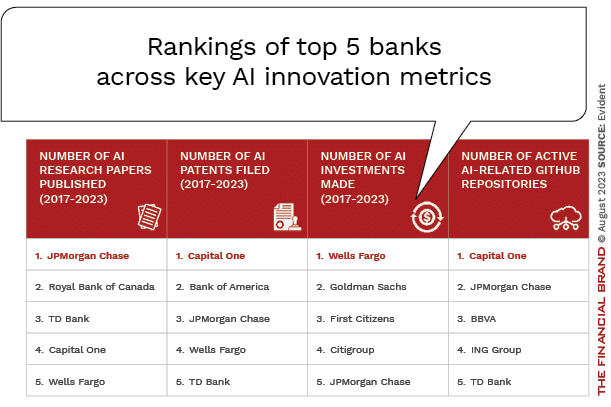
The overarching finding is clear: a handful of North American banks have sprinted ahead in the race for AI maturity, staking out early leadership positions that will be extremely difficult for lagging competitors to overcome. JPMorgan Chase, Capital One, Wells Fargo and Royal Bank of Canada stand out for aggressive, holistic pursuit of cutting-edge AI innovation.

top-banks-across-key-AI-innovation-metrics

The value to other financial institutions is that the AI leaders share common attributes and strategies that other banks and credit unions can learn from. At the core, AI leaders have made innovation in this technology an urgent strategic priority by visibly demonstrating their support. They have committed substantial financial resources and talent to AI progress.

Read More: 3 Strategies for Enterprise AI Success That Are Tried and ‘Truist’

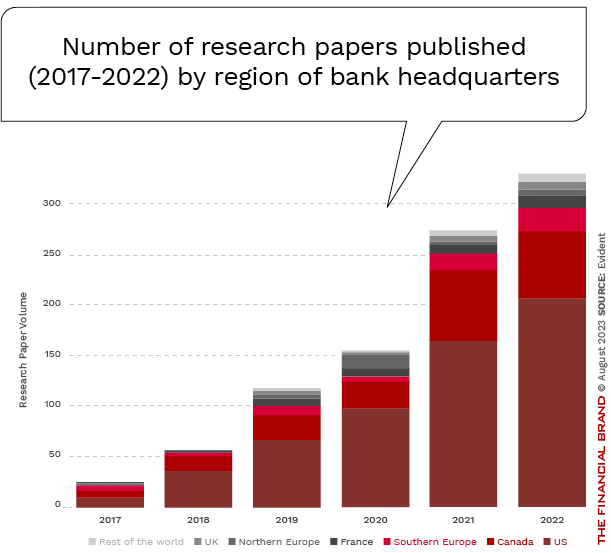
Establishing centralized AI research teams is a hallmark of the most advanced financial organizations, tasked with both pure and applied research. Many firms that don’t spend on such projects may wonder why creating research on AI solutions matters. Leading firms recognize that research teams power innovation, attract top talent and speed reaction to AI advances. The report reaffirms North America’s expanding advantage, with US and Canadian banks accounting for 80% of publications.

Number_of research papers published 2017_2022 by region of_bank headquarters

Leaders were also aggressive at filing patents to protect intellectual property and gain competitive advantage. Again, North American banks prevailed, with 99% of patents in the most recent years tracked residing in the US and Canada. Of special note, Capital One’s streamlined patent approval process demonstrates the cultural focus leaders can instill. While regulations differ, European banks must overcome cultural gaps to compete on patents. Similar to creating research, while patents don’t guarantee success, they do appeal to AI talent looking for progressive financial institutions.

No institution can deliver AI maturity single handedly. Tapping into shared innovation through diverse collaborations is essential. Savvy banks are building web-like networks spanning open source communities, universities, accelerators and third-party solution providers. This cooperation with outside expertise gives access to greater flows of ideas, technologies and partnerships. Active open source participation also signals engineering strength, according to Evident Insights.

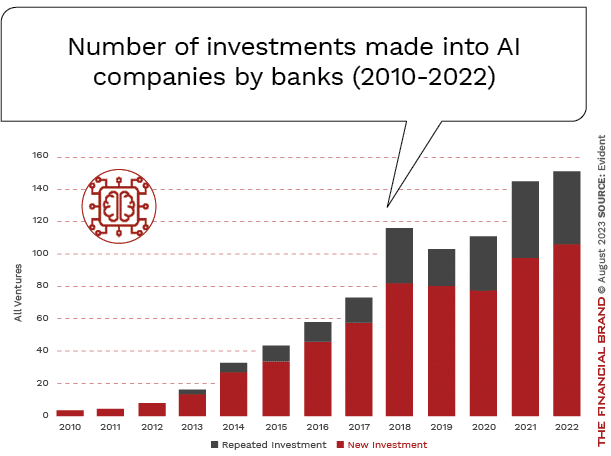
Finally, the report finds that banks have been ramping up their AI startup investments, with deal volume growing 15% annually from 2017-2022. However, there are pronounced regional differences. Historically, US banks dominated, accounting for 89% of deals in 2015. But while still leading, their share has fallen to 61% by 2022 as European banks, especially French institutions, increase their focus in this area.

Number_of banking investments made into AI companies_2010_2022

Overall, the top five US banks – Wells Fargo, Goldman Sachs, First Citizens, Citi and JPMorgan Chase – account for over 50% of all AI startup investments. Wells Fargo leads, having made 157 deals. Goldman Sachs has broad exposure through over 100 deals across various subsidiaries. (First Citizens entered the top ranks after acquiring Silicon Valley Bank.)

In terms of recipients, 60% of AI startups backed by banks are US-based. However, US banks are more globally diversified, deploying substantial capital in Asia and Europe. In contrast, European banks concentrate domestically, with French institutions heavily backing local AI startups.


Four Health IT Experts Point to Impactful Trends in 2024

Source: www.healthcareitnews.com.

“Forward-thinking provider organizations will … augment their EHRs through fully integrated, consumer-friendly tools that help reduce call volume and alleviate repetitive, manual workflows.”

“There is a renewed and intensified focus on economics, efficiencies and automation, and a cautious approach to limited application of AI to leverage less skilled and tedious tasks such as medical scribing.”

“Healthcare organizations … should lean into the proven measurable results from applications such as machine learning and natural language processing.”

These are some of the predictions from four healthcare information technology experts Healthcare IT News rounded up to offer readers thoughts on the year ahead.

Patty Riskind, CEO, Orbita

“The industry must show demonstrable progress in making healthcare as self-service as possible for patients,” said Patty Riskind, CEO of Orbita, a vendor of smart virtual assistants and workflow automation for healthcare. “This will not only benefit patients but also help alleviate the administrative burden on clinicians and staff.

“While EHR vendors have long said they will incorporate digital tools within their systems, their development priorities, by necessity, must focus on compliance and regulatory updates.

“Forward-thinking provider organizations will more aggressively seek partners to augment their EHRs through fully integrated, consumer-friendly tools that help reduce call volume and alleviate repetitive, manual workflows, resulting in more efficient operations and enhanced staff and patient engagement.”

Dr. David J. Sand, chief medical officer, ZeOmega

“Healthcare organizations across the care delivery spectrum are reckoning with the continued fallout from COVID, including staff burnout and staffing shortages, striking healthcare workers, and shifts in their revenue base,” said Dr. David J. Sand, chief medical officer at ZeOmega, an enterprise healthcare management organization.

“There is a renewed and intensified focus on economics, efficiencies and automation, and a cautious approach to limited application of AI to leverage less skilled and tedious tasks such as medical scribing.

“Last year, I predicted we would see an increase in M&A activity involving highly leveraged healthcare tech companies, many of which, while having impressive intellectual capital, had yet to create margins or revenue streams to substantiate their valuations.

“We are now seeing these companies, from insurtechs to AI-driven vendors, simply shuttering their operations, leaving others in the field to ‘hold the bag.'”

Dr. Emad Rizk, chairman, president and CEO, Cotiviti

“Healthcare is under significant pressure and change following the COVID-19 public health emergency, specifically a workforce shortage and increasing costs from wage increases and inflation,” said Dr. Emad Rizk, chairman, president and CEO of Cotiviti, a vendor of advanced technology and data analytics for healthcare organizations. “The industry is responding to these pressures by looking at ways technology can improve productivity and the quality of care delivery.

“As healthcare organizations look at these new technologies, they should take a measured approach while leaning into the proven measurable results from other applications such as machine learning and natural language processing.

“These technologies must be guided by human medical and investigative expertise, and nationally accepted guidelines by medical societies and academies. Technology can never work in a vacuum without human judgement and clinical expertise.

“In 2024, as the industry continues to explore and adopt various forms of new technologies presented to them, health plans must weigh the opportunities and risks as they develop a rigorous approach to their application, focusing on how they can help to maximize effectiveness – and always deploying them alongside human expertise, with appropriate safeguards to ensure compliance while improving value.”

Rajesh Subramaniam, managing director and CEO, ResultsCX

“The healthcare landscape is undergoing a significant transformation driven by the growing emphasis on patient engagement and empowerment,” said Rajesh Subramaniam, managing director and CEO of ResultsCX, a vendor of customer experience management systems. “Research cited in Forbes indicates 80% of consumers are inclined to connect with and remain loyal to brands that offer personalized experiences.”