Broadleaf Services Teams with Echelon Services and SPAARK to Deliver Strategic Data Analytics Support Services to a DoD Agency

Description of Work Performed: Broadleaf Services supports a broad spectrum of analytical and data visualization, data exploitation, management consulting, and support services necessary for implementing Artificial Intelligence/ Machine Learning (AI/ML) applications in the Contract Administration field. Specifically, Broadleaf Services applies expertise in professional consulting services to assist with the full range of business intelligence program/project management services necessary to implement a data strategy for DCMA, which is expected to evolve over the contract’s period of performance. These capabilities include a wide range of functional data management disciplines, including data exploitation and analysis, data visualization and dashboard strategy, application program and project management, and data management.

Broadleaf Services provides the COR with Monthly and Quarterly Progress Reports, covering all work completed during the reporting period and work planned for the subsequent reporting period. These reports also identify any problems that arose and give a description of how the problems were resolved. For any unresolved issues, Broadleaf Services provides an explanation including a plan and timeframe for resolution.  We monitor progression against the Performance Plan and report any deviations to prevent the need for escalation.

Background of DCMA Analytic Requirement: DCMA Chief Data Officer (CDO) requires additional resources and expertise to efficiently and effectively execute its responsibility for managing the Agency’s data resources and ensuring that DCMA complies with Federal law, Department of Defense (DOD) Directives and oversight, and internal policy and requirements.  Legal and statutory requirements include those specified in the Paperwork Reduction Act, Privacy Act, Federal Records Act, the Freedom of Information Act (FOIA), the Clinger-Cohen Act, and the Data Quality Act. Federal oversight requirements include policy and guidance documents issued by the Office of Management and Budget (OMB), the Government Accountability Office (GAO), and the Executive Office of the President. Internal requirements include those issued by the agency’s Inspector General, the agency’s Director, and the Chief Information Office (CIO).

As a DOD Combat Support Agency, DCMA ensures the integrity of the contracting process and provides a broad range of contract-procurement management and administrative services to ensure a valued product is being delivered promptly and ready for use by America’s Warfighters. DCMA works directly with Defense suppliers to ensure that DOD, Federal, and allied Government supplies and services are delivered on time, at projected cost, and meet all performance requirements. With headquarters in Fort Gregg-Adams, Virginia, DCMA employs approximately 10,000 civilian and military professionals with over 800 distinct and supported employee duty stations worldwide.  DCMA’s Chief Data and Analytics Office includes approximately 25 Government and contractor personnel around the world.

Broadleaf Services provides professional services in the following areas:

  • Advanced Analytics
  • Data Strategy Development and Implementation
  • Data Science
  • Performance Management Integration
  • Data Analytics
  • Dashboard and Data Visualization Support
  • Data Visualization Sub-tasks
  • Application Development Support
  • Application Development Support Sub-Tasks
  •  Artificial Intelligence (AI) and Machine Learning (ML) Planning and Implementation
  • Enterprise Architecture (Data Architecture and Data Management)
  • Research and Analysis of the Current State
  • Conceptual Architecture Diagrams and Artifacts


Transforming Government Operations: The Revolutionary Impact of AI Technologies

By Broadleaf Services

In an era where digital transformation is not just a buzzword but a necessity, Artificial Intelligence (AI) stands at the forefront of this revolution, especially in the realm of government operations. As a government IT contractor, I’ve witnessed firsthand the transformative power of AI in redefining how government services are delivered and decisions are made. This blog post delves into the myriad ways AI technologies are revolutionizing government operations, enhancing efficiency, and paving the way for faster, more accurate decision-making.

The AI Revolution in Government Operations

Enhanced Efficiency and Productivity

AI technologies are instrumental in automating routine tasks, from data entry to complex analytics. This automation not only speeds up processes but also minimizes human error, leading to more efficient and reliable government operations. For instance, AI-driven chatbots are now handling citizen queries, freeing up human resources for more complex tasks that require human empathy and understanding.

Improved Decision-Making

AI’s ability to process and analyze vast amounts of data far exceeds human capabilities. Governments are leveraging AI to sift through big data, deriving insights that inform policymaking and resource allocation. This data-driven approach ensures that decisions are based on comprehensive analysis, leading to more effective and targeted policies.

Predictive Analytics for Proactive Governance

AI’s predictive capabilities are a game-changer for government operations. By analyzing trends and patterns, AI can forecast potential issues, from public health crises to infrastructure needs, allowing governments to adopt a proactive rather than reactive approach. This foresight is crucial in resource planning and crisis management.

Enhancing Public Safety and Security

AI technologies play a pivotal role in public safety, from smart surveillance systems that enhance security to predictive policing tools that help in crime prevention. AI-driven systems can analyze data from various sources, identify potential threats, and enable quicker, more effective responses.

Challenges in AI Integration

Despite the benefits, integrating AI into government operations is not without its challenges.

    1. Data Privacy and Security

 With AI systems handling vast amounts of sensitive data, ensuring privacy and security is paramount. Governments must establish robust data governance frameworks to protect citizen data from breaches and misuse.

    1. Ethical Considerations and Bias:

AI systems are only as unbiased as the data they are fed. There’s a growing concern about AI algorithms perpetuating existing biases, leading to unfair or unethical outcomes. Ensuring AI ethics and fairness is a significant challenge that needs continuous attention.

    1. Skill Gap and Workforce Transformation:

The shift towards AI-driven operations requires a workforce skilled in new technologies. This transition poses a challenge in terms of retraining and reskilling employees to work alongside AI systems effectively.

    1. Integration with Existing Systems:

Integrating AI technologies with legacy systems in government poses technical and compatibility challenges. Seamless integration is crucial for maximizing the benefits of AI.

Conclusion

The integration of AI into government operations is not just a futuristic concept but a present reality. The benefits of AI in enhancing efficiency, improving decision-making, and enabling proactive governance are immense. However, navigating the challenges of data privacy, ethical considerations, workforce transformation, and technical integration is crucial for realizing the full potential of AI in government operations. As we continue to embrace this AI revolution, it’s essential to approach it with a balanced view, addressing challenges while harnessing its transformative power for the greater good of public service and governance.

Embracing AI in government operations is a journey, not a destination. It requires continuous learning, adaptation, and collaboration. I invite you to join the conversation – share your thoughts, experiences, and insights on how AI is transforming government operations in your sphere. Let’s collaborate to make the AI revolution in government a success for all.

Navigating the Ethical Landscape of AI in Government: Balancing Innovation with Integrity

By Broadleaf Services

The integration of Artificial Intelligence (AI) in government operations marks a significant leap forward in public service efficiency and decision-making. However, this technological advancement brings with it a complex array of ethical considerations that must be addressed to maintain citizen trust and safety. In this blog post, we delve into the critical ethical issues of privacy, bias, and transparency in AI applications within government sectors, emphasizing the urgent need for robust ethical frameworks.

The Ethical Imperatives of AI in Government

Privacy Concerns in the Age of AI

AI systems, with their unparalleled data processing capabilities, can inadvertently become tools that infringe on individual privacy. Governments collect and store vast amounts of personal data, and the use of AI to analyze this data raises significant privacy concerns. Ensuring that AI systems respect citizen privacy and comply with data protection laws is paramount. This involves implementing strict data governance policies and ensuring that AI algorithms are designed to protect personal information from unauthorized access or misuse.

Combating Bias and Ensuring Fairness

AI systems are only as unbiased as the data they are trained on. There is a growing concern that AI, if not carefully managed, can perpetuate existing societal biases, leading to discriminatory outcomes in areas like law enforcement, social welfare, and public services. Governments must prioritize the development of AI systems that are fair and impartial. This involves auditing datasets for bias, developing diverse training datasets, and continuously monitoring AI systems for discriminatory patterns.

Transparency and Accountability in AI Systems

The ‘black box’ nature of many AI algorithms poses a significant challenge to transparency and accountability. For citizens to trust AI-driven government decisions, they need to understand how these decisions are made. Ensuring transparency in AI processes and being accountable for AI-driven outcomes is crucial. This can be achieved by implementing explainable AI (XAI) practices, where AI decisions can be understood and explained in human terms.

The Need for Ethical Frameworks

Developing and implementing ethical frameworks for AI in government is not just a recommendation but a necessity. These frameworks should:

– Establish Clear Ethical Guidelines: Define what constitutes ethical AI use within government operations, including respect for privacy, fairness, and transparency.

– Ensure Regulatory Compliance: Align AI practices with existing laws and regulations, and adapt policies to accommodate the evolving nature of AI technologies.

– Promote Cross-Sector Collaboration: Encourage collaboration between government entities, AI developers, ethicists, and the public to address ethical challenges comprehensively.

– Foster Continuous Learning and Adaptation: Recognize that AI ethics is a rapidly evolving field and commit to ongoing learning and adaptation of ethical standards.

Conclusion

As AI continues to reshape government operations, navigating its ethical landscape becomes increasingly critical. Addressing privacy concerns, combating bias, and ensuring transparency are not just ethical imperatives but foundational elements for building citizen trust and safety in AI-driven government services. The development and implementation of robust ethical frameworks are essential to harness the benefits of AI while safeguarding the values of our society.

The journey towards ethical AI in government requires collective effort and continuous dialogue. I encourage policymakers, technologists, ethicists, and citizens to engage in this crucial conversation. Share your insights, raise concerns, and contribute to developing frameworks that ensure AI in government is not only efficient and innovative but also ethical and just. Let’s work together to create a future where AI serves the public good, respecting our rights, values, and dignity.

Microsoft Fends off AI Data Concerns With Private-Server ChatGPT Solution

Source: www.pymnts.com.

The commercial viability of artificial intelligence (AI) is officially here, and so are its pitfalls.

At the center of many enterprise concerns around the use of innovative generative AI solutions is the same thing at the center of the tools themselves: questions around the data and information fed to the AI models and that data’s provenance and security.

Microsoft is reportedly planning to sell a privacy-focused version of OpenAI’s ChatGPT chatbot to business customers concerned about regulatory compliance and data leaks.

The product is designed to allay firms’ fears around employees inadvertently giving the chatbot access to proprietary information when they use it — as Samsung engineers did last month.

Many businesses harbor worries around the fact that AI platforms store their data on external servers and often continually re-train their AI’s large language models (LLM) by leveraging user-submitted information.

This means that a query about a company-specific proprietary process could end up being used to inform an answer to a competitor’s own request of a similar nature, as long as both organizations use ChatGPT.

That’s why the private solution from Microsoft will run on its own dedicated servers, separate from the ones used by other companies and individuals using ChatGPT for less sensitive or business-critical tasks. Per the report, the solution’s dedicated private server space won’t be cheap and may run interested organizations up to 10 times the normal cost.

See also: Companies Tap Their Own Data to Drive Efficiencies With AI

Businesses Race to Integrate and Offer AI Solutions

“Pretty much every organization is thinking about how to use generative AI” to achieve efficiencies, Alphabet and Google CEO Sundar Pichai said last month.

Businesses are racing to integrate AI solutions that can connect historically disparate and fragmented data to get a more unified picture of their operations, as well as identify previously obscured opportunity areas.

And tech companies are racing to be the ones that provide those next-generation solutions to them.

IBM unveiled Tuesday (May 9) watsonx, an AI platform to help businesses integrate AI. while Wendy’s and Google have teamed to bring automated voice AI ordering to the fast-food chain’s drive-thrus.

PYMNTS research found that 54% of consumers said they would prefer using voice technology in the future because it is faster than typing or using a touchscreen.

Still, the increasing adoption of generative AI tools and automated machine learning (ML) solutions isn’t without its accompanying disruptions and growing pains.

Spotify has reportedly pulled tens of thousands of AI-generated songs from its platform, while TikTok is developing a tool that flags AI-generated videos to users.

“There is a lot of value [around generative AI capabilities], but the key question is when can we use it without the fear of bias and where this information is coming from,” Bank of America CEO Brian Moynihan said in April. “We need to understand how the AI-driven decisions are made…”

Enacting Regulation to Protect Privacy and Spur Growth

Data rests at the heart of the generative AI tools and capabilities that represent the next wave of economic innovation.

Data is foundational to building the models, training the AI,” Michael Haney, head of Cyberbank Digital Core at FinTech platform Galileo, the sister company of Technisys, told PYMNTS in March. “The quality and integrity of that data is important…”

By enacting guardrails around the provenance of this data being used in LLMs and other training models, including making it obvious when an AI model is generating synthetic content such as text, images and even voice applications and flagging its source, governments and regulators can protect consumer privacy without hampering private sector innovation and growth.

“AI is one of the most powerful technologies of our time, but in order to seize the opportunities it presents, we must first mitigate its risks,” the White House said Thursday (May 4).

While policymakers continue to struggle to enact effective oversight of generative AI, areas like healthcare have the opportunity to serve as a best practice standard bearer around data privacy protections and data set integrity and provenance.

As the world continues to undergo a tectonic shift driven by the technical capabilities of AI applications, both private enterprises and public leaders will need to work together to promote fair competition while protecting end-users.


Air Force DCIO: Modernizing is ‘Biggest Thing’ to Improve Cybersecurity

Source: www.meritalk.com.

Many Federal agencies are looking to use AI as a key cybersecurity tool, but before agencies get too far ahead of themselves, U.S. Air Force Deputy Chief Information Officer (DCIO) Winston Beauchamp said on Tuesday that the number one thing agencies can do to improve their cybersecurity posture is to modernize their IT architecture.

“I continue to say that the single biggest thing we can do to improve our cybersecurity is modernize our architecture, get rid of our tech debt,” Beauchamp said at the Google Public Sector Summit, presented by Scoop News Group, on Oct. 17. “Because our decrepit, older systems that are out of service by the vendors that built them can’t provide the cybersecurity that we need to survive in today’s environment.”

The deputy CIO said that cybersecurity and AI have something in common, which is that they are both “strapped on after the fact” to legacy systems. This means that cybersecurity and AI capabilities are “really limited” by their infrastructure and the data they have access to, he explained.

However, Beauchamp said that “another thing that they both have in common is that both cybersecurity and artificial intelligence are baked in.” According to Beauchamp, these capabilities are baked into the tools, infrastructure, and basic internet appliances that we use to modernize our networks.

For this reason, he said that “modernizing is number one,” when it comes to improving agencies’ cybersecurity.

“When you modernize, you bring in capabilities that for cybersecurity and artificial intelligence that are baked in, they’re inherent to what you’re delivering,” Beauchamp said. “So, we’re very optimistic about what that future brings.”

“And then the nice thing about it is from an infrastructure perspective, we don’t have to think about designing it. It comes out of the box,” he added. “We’ll tailor it, and we’ll customize it for the mission.”

Nevertheless, Beauchamp said that AI also needs to be on the list of cybersecurity to-dos in order to keep up with our adversaries, who are using AI to tailor their attacks to “basically work around our signature management approach.”

“They can do so at speed faster than we can update our signatures, so we have to run faster,” he said. “And that means using AI to try a different approach other than signature management … I think there’s going to be a ‘guns versus armor’ back and forth for some time on AI’s use in cybersecurity, and we just have to be better and faster than our adversaries.”


Deloitte on Tech: Top Cloud Computing Trends to Expect in 2024

Source: www.sdxcentral.com.

Predicting the future of anything is easier than you think. You look at the trends occurring now and figure out a path through those trends for a specific period.

Cloud computing is no different. You just have to ask, what are the issues that we’ll be dealing with?  What technology will we be focusing on?  How will this likely play out for enterprises?

To answer these questions, we need to focus on three major trends that are occurring in 2023 and will likely be a factor in 2024.  They are the following:

  1. The move to ubiquitous and heterogeneous computing
  2. The rise of generative artificial intelligence (genAI) supporting infrastructure
  3. The continued need for cloud computing skills

The move to ubiquitous and heterogeneous computing

This is a significant trend that will likely continue through 2024 and beyond. The idea is that, while we’ve focused on moving to new and combined platforms, namely the public cloud, the trend is now to consider all platforms and to put the workloads and the data on platforms that make the most sense.

This began in the cloud world through the movement to multicloud deployments. The idea was that just using a single cloud provider limited the capabilities or cloud services you can access. Thus, adding more public clouds to the mix of systems you can leverage for any business purpose means you have more capabilities, including the higher likelihood that you’ll be leveraging best-of-breed solutions.

However, the movement to ubiquitous computing is more than just multicloud. Indeed, it’s about leveraging anything that makes sense, from mobile computing platforms, such as your smartphone or smartwatch, to traditional computing platforms, to the ones you usually find in enterprise data centers, to all kinds of cloud platforms — including those offered by major cloud providers, or “micro clouds,” that may only provide industry-specific services (e.g., industry clouds) supporting specific industries such as finance, healthcare, manufacturing, etc.

There are a few significant factors driving this trend. First, the hardware cost, including storage and computing, has fallen significantly in the last five years. This means that, in many cases, it can be more cost-effective. Second, cloud prices can get quite high, exacerbated by enterprises that aren’t optimizing these platforms. This can easily become a self-inflicted wound that makes the cost of cloud computing much too high if not addressed.

These trends will materialize in a few critical enterprise behaviors in 2024, including repatriating some cloud applications and data back to more traditional data centers. They will, however, lose the benefits of a public cloud, such as colocation with several valuable services like AI, serverless computing, state-of-the-art security, managed container orchestration, etc.

Also, there will be a focus on non-cloud and non-data center platforms, such as mobile computing and edge computing. The reduced hardware prices and greater availability will drive this and the rise of ubiquitous high-speed networking, such as 5G. This phenomenon makes access more cost effective and valuable. Thus, we’ll be able to leverage these resources wherever they exist. Or, better put, we will see a rise in ubiquitous access and resources within and outside of public cloud platforms.

The increase of genAI supporting infrastructure

This trend is a reaction to the rise of genAI, both in the cloud and not on the cloud. As enterprises see the value in using this technology and move from proof of concept to production systems, they will spend 2024 building the infrastructure to support genAI systems — both net-new and newly AI-enabled applications — both on the public clouds and not on the public clouds, including data centers, edge computing and mobile computing.

Much needs to be done to support this rise, though, including sizing systems for genAI. This means typically supporting training data with more database storage and keeping the storage of both structured and unstructured data. In many instances, enterprises will look to combine that data before it becomes training data, and that will likely work in the public clouds, given the ease of provisioning and scaling of cloud-based platforms.

Also, additional and sometimes different computing needs to be found. GPUs (graphics processing units) are more critical in genAI; thus, most are found and allocated. However, more traditional CPUs also play a role, and using specialized cloud services may be the easiest path to genAI for many enterprises.

As a result, cloud providers will see explosive growth around this trend in 2024. Traditional computing and storage platforms will also see changes, as many enterprises may opt to keep their productive AI systems on-premises for security and cost-efficiency reasons. At the same time, it will be a rising tide that raises all ships in 2024.

The continued demand for cloud computing skills

This is an old issue that we’ll see become more significant in 2024. This is due to the previous trends we mentioned and the expansion of the need for qualified people to design and build these systems.

Indeed, if you consider the way cloud has grown exponentially over the past several years, it’s not only been due to the capability of the cloud services; it’s also been the result of going too fast and not having the skillsets in place to make sure that the cloud deployment is cost-optimized to return the maximum value to the business. How do we address this?

Colleges and universities can help develop these skills in their graduates. Also, enterprises need to develop internal training programs to support the sharpening of their current employees’ skills.

In 2024, enterprises will likely become cleverer in this regard, such as focusing on skills-first hiring and supporting programs that attract specific groups of people to the profession — like those returning to the workplace after raising a family, veterans returning to civilian work, and individuals without a four-year college degree. They may also look to support internal upskilling through monetary incentives.

So, will all of this likely happen in 2024? We’ll have to stay tuned to find out.


Artificial Intelligence: DOD Needs Department-Wide Guidance to Inform Acquisitions

Source: www.gao.gov.

The Department of Defense is developing artificial intelligence capabilities—computer systems that can do tasks that normally require human intellect.

The private sector has been acquiring AI for years. Thirteen private companies told us about their AI acquisition practices. For example, some companies mentioned the importance of considering intellectual property and data rights when negotiating contracts for AI projects.

Although parts of DOD are already using AI, DOD hasn’t issued department-wide AI acquisitions guidance needed to ensure consistency. We recommended it develop such guidance—considering private company practices as appropriate.

What GAO Found

The Department of Defense (DOD) designated artificial intelligence (AI) a top modernization area and is allocating considerable spending to develop AI tools and capabilities. AI refers to computer systems designed to replicate a range of human functions and continually get better at their assigned tasks. DOD AI capabilities could be used in various ways, for example in identifying potential threats or targets on the battlefield.

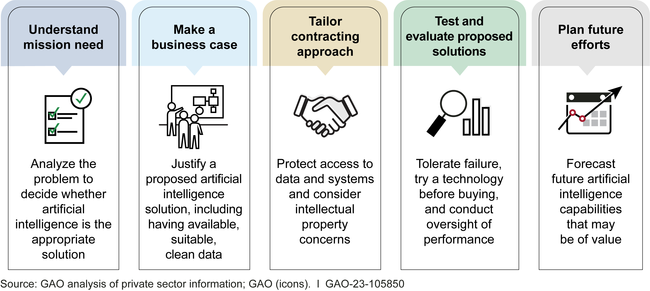
GAO obtained information from 13 private sector companies about how they successfully acquire AI capabilities. Elements of these categories, shown below, are also reflected in GAO’s June 2021 AI Accountability Framework report (GAO-21-519SP).

Categories of Factors Selected Companies Reported Considering When Acquiring Artificial Intelligence Capabilities

Categories of Factors Selected Companies Reported Considering When Acquiring Artificial Intelligence Capabilities

Although numerous entities across DOD are acquiring, developing, or already using AI, DOD has not issued department-wide guidance for how its components should approach acquiring AI. DOD is in the process of planning to develop such guidance, but it has not defined concrete plans and has no timeline to do so. The military services also lack AI acquisition-specific guidance, though military officials noted that such guidance would be helpful to navigate the AI acquisition process. Without department-wide and tailored service-level guidance, DOD is missing an opportunity to ensure that it is consistently acquiring AI capabilities in a manner that accounts for the unique challenges associated with AI.

Various DOD components and military services have individually developed or plan to develop their own informal AI acquisition resources. Some of these resources reflect key factors identified by private companies for AI acquisition. For example, DOD’s Chief Digital and AI Officer oversees an AI marketplace known as Tradewind, which is designed to expedite the procurement of AI capabilities. Several Tradewind resources emphasize the need to consider intellectual property and data rights concerns when negotiating contracts for AI capabilities, a key factor identified by the companies GAO interviewed.

Why GAO Did This Study

DOD has begun to pursue increasingly advanced AI capabilities. DOD has historically struggled to acquire weapon systems software, and AI acquisitions pose additional challenges. In February 2022, GAO described the status of DOD’s efforts to develop and acquire AI for weapon systems.

Senate Report 116-236 accompanying the National Defense Authorization Act for Fiscal Year 2021 includes a provision for GAO to review DOD’s AI acquisition efforts. This is the second report in response to that provision. This report examines (1) key factors that selected private companies reported considering when acquiring AI capabilities, and (2) the extent to which DOD has department-wide AI acquisition guidance and how, if at all, this guidance reflects key factors identified by private sector companies.

GAO analyzed information provided by 13 private companies with expertise in designing, developing, and deploying AI systems in various sectors to determine the key factors. GAO also analyzed DOD documentation and compared it with the key factors, and interviewed DOD officials.

Recommendations

GAO is making four recommendations for DOD and the three military departments to develop guidance on acquiring AI capabilities, leveraging private company factors as appropriate. DOD concurred with the recommendations.

Recommendations for Executive Action

Agency Affected Recommendation Status
Department of Defense The Secretary of Defense should ensure that the Chief Digital and AI Officer, in conjunction with other DOD acquisition policy offices as appropriate, prioritize establishing department-wide AI acquisition guidance, including leveraging key private company factors, as appropriate. (Recommendation 1)
Open 
 
When we confirm what actions the agency has taken in response to this recommendation, we will provide updated information.
Department of the Army After DOD issues department-wide AI acquisition guidance, the Secretary of the Army should establish service-specific AI acquisition guidance that includes oversight processes and clear goals for these acquisitions, and leverages key private company factors, as appropriate. (Recommendation 2)
Open 
 
When we confirm what actions the agency has taken in response to this recommendation, we will provide updated information.
Department of the Navy After DOD issues department-wide AI acquisition guidance, the Secretary of the Navy should establish service-specific AI acquisition guidance that includes oversight processes and clear goals for these acquisitions, and leverages key private company factors, as appropriate. (Recommendation 3)
Open 
 
When we confirm what actions the agency has taken in response to this recommendation, we will provide updated information.
Department of the Air Force After DOD issues department-wide AI acquisition guidance, the Secretary of the Air Force should establish service-specific AI acquisition guidance that includes oversight processes and clear goals for these acquisitions, and leverages key private company factors, as appropriate. (Recommendation 4)
Open 
 
When we confirm what actions the agency has taken in response to this recommendation, we will provide updated information.


The Importance of Continuous AI Innovation in Banking

Source: www.thefinancialbrand.com.

Despite all of the talk about AI in financial services, banks and credit unions struggle to know where to start and where best to deploy resources at a time of continued economic uncertainty. Few would argue against the premise that adopting new AI technologies is essential for financial institutions to keep pace with changing customer expectations, to defend business against fintech, big bank and non-financial challengers, and to operate more efficiently.

The key is to maximize AI maturity across the entire organization, reimagining and improving products, services, and processes, hyper-personalizing communication and recommendations to customers, automating manual workflows, and proactively identifying and mitigating emerging risks.

What is “AI maturity”? The term represents the level of commitment, deployment and success of artificial intelligence initiatives in an organization.

Failing to innovate with AI is increasingly putting banks and credit unions at existential risk of falling behind the competition. The AI Innovation Report from Evident Insights found that focusing on AI innovation enables the complete transformation of banks into data-centric organizations. AI innovation also enables leading banks and credit unions to envision the future of financial services, and take the necessary steps to remain dominant players going forward. The report maintains that organizations that fail to make AI innovation core to their strategy risk being left behind in what is increasingly, at least among the largest players, becoming an AI-first industry.

Breaking Down AI Maturity in Banking

Evident Insights’ report examines AI innovation across major banks in North America and Europe. The report analyzes AI maturity across key pillars including research, patents, ecosystems, investments and lessons for leaders.

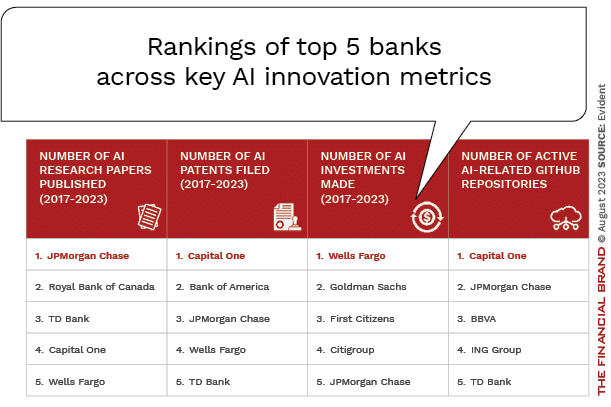
The overarching finding is clear: a handful of North American banks have sprinted ahead in the race for AI maturity, staking out early leadership positions that will be extremely difficult for lagging competitors to overcome. JPMorgan Chase, Capital One, Wells Fargo and Royal Bank of Canada stand out for aggressive, holistic pursuit of cutting-edge AI innovation.

top-banks-across-key-AI-innovation-metrics

The value to other financial institutions is that the AI leaders share common attributes and strategies that other banks and credit unions can learn from. At the core, AI leaders have made innovation in this technology an urgent strategic priority by visibly demonstrating their support. They have committed substantial financial resources and talent to AI progress.

Read More: 3 Strategies for Enterprise AI Success That Are Tried and ‘Truist’

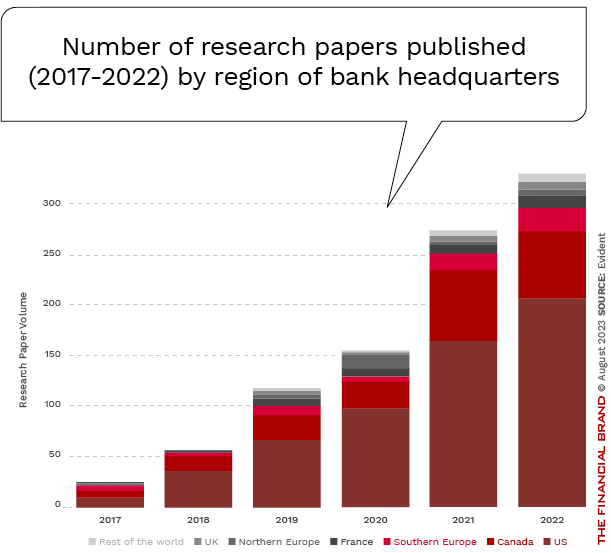
Establishing centralized AI research teams is a hallmark of the most advanced financial organizations, tasked with both pure and applied research. Many firms that don’t spend on such projects may wonder why creating research on AI solutions matters. Leading firms recognize that research teams power innovation, attract top talent and speed reaction to AI advances. The report reaffirms North America’s expanding advantage, with US and Canadian banks accounting for 80% of publications.

Number_of research papers published 2017_2022 by region of_bank headquarters

Leaders were also aggressive at filing patents to protect intellectual property and gain competitive advantage. Again, North American banks prevailed, with 99% of patents in the most recent years tracked residing in the US and Canada. Of special note, Capital One’s streamlined patent approval process demonstrates the cultural focus leaders can instill. While regulations differ, European banks must overcome cultural gaps to compete on patents. Similar to creating research, while patents don’t guarantee success, they do appeal to AI talent looking for progressive financial institutions.

No institution can deliver AI maturity single handedly. Tapping into shared innovation through diverse collaborations is essential. Savvy banks are building web-like networks spanning open source communities, universities, accelerators and third-party solution providers. This cooperation with outside expertise gives access to greater flows of ideas, technologies and partnerships. Active open source participation also signals engineering strength, according to Evident Insights.

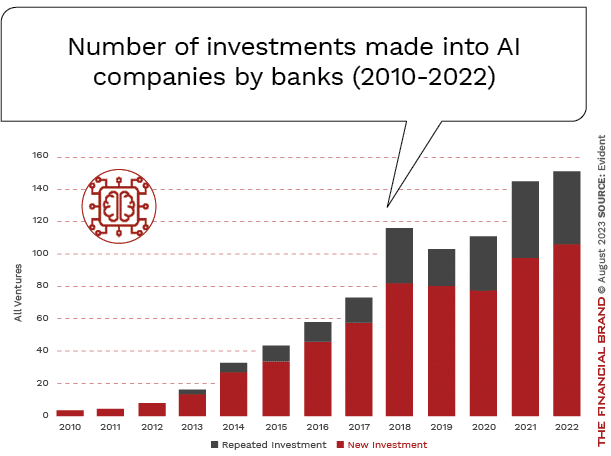
Finally, the report finds that banks have been ramping up their AI startup investments, with deal volume growing 15% annually from 2017-2022. However, there are pronounced regional differences. Historically, US banks dominated, accounting for 89% of deals in 2015. But while still leading, their share has fallen to 61% by 2022 as European banks, especially French institutions, increase their focus in this area.

Number_of banking investments made into AI companies_2010_2022

Overall, the top five US banks – Wells Fargo, Goldman Sachs, First Citizens, Citi and JPMorgan Chase – account for over 50% of all AI startup investments. Wells Fargo leads, having made 157 deals. Goldman Sachs has broad exposure through over 100 deals across various subsidiaries. (First Citizens entered the top ranks after acquiring Silicon Valley Bank.)

In terms of recipients, 60% of AI startups backed by banks are US-based. However, US banks are more globally diversified, deploying substantial capital in Asia and Europe. In contrast, European banks concentrate domestically, with French institutions heavily backing local AI startups.


Four Health IT Experts Point to Impactful Trends in 2024

Source: www.healthcareitnews.com.

“Forward-thinking provider organizations will … augment their EHRs through fully integrated, consumer-friendly tools that help reduce call volume and alleviate repetitive, manual workflows.”

“There is a renewed and intensified focus on economics, efficiencies and automation, and a cautious approach to limited application of AI to leverage less skilled and tedious tasks such as medical scribing.”

“Healthcare organizations … should lean into the proven measurable results from applications such as machine learning and natural language processing.”

These are some of the predictions from four healthcare information technology experts Healthcare IT News rounded up to offer readers thoughts on the year ahead.

Patty Riskind, CEO, Orbita

“The industry must show demonstrable progress in making healthcare as self-service as possible for patients,” said Patty Riskind, CEO of Orbita, a vendor of smart virtual assistants and workflow automation for healthcare. “This will not only benefit patients but also help alleviate the administrative burden on clinicians and staff.

“While EHR vendors have long said they will incorporate digital tools within their systems, their development priorities, by necessity, must focus on compliance and regulatory updates.

“Forward-thinking provider organizations will more aggressively seek partners to augment their EHRs through fully integrated, consumer-friendly tools that help reduce call volume and alleviate repetitive, manual workflows, resulting in more efficient operations and enhanced staff and patient engagement.”

Dr. David J. Sand, chief medical officer, ZeOmega

“Healthcare organizations across the care delivery spectrum are reckoning with the continued fallout from COVID, including staff burnout and staffing shortages, striking healthcare workers, and shifts in their revenue base,” said Dr. David J. Sand, chief medical officer at ZeOmega, an enterprise healthcare management organization.

“There is a renewed and intensified focus on economics, efficiencies and automation, and a cautious approach to limited application of AI to leverage less skilled and tedious tasks such as medical scribing.

“Last year, I predicted we would see an increase in M&A activity involving highly leveraged healthcare tech companies, many of which, while having impressive intellectual capital, had yet to create margins or revenue streams to substantiate their valuations.

“We are now seeing these companies, from insurtechs to AI-driven vendors, simply shuttering their operations, leaving others in the field to ‘hold the bag.'”

Dr. Emad Rizk, chairman, president and CEO, Cotiviti

“Healthcare is under significant pressure and change following the COVID-19 public health emergency, specifically a workforce shortage and increasing costs from wage increases and inflation,” said Dr. Emad Rizk, chairman, president and CEO of Cotiviti, a vendor of advanced technology and data analytics for healthcare organizations. “The industry is responding to these pressures by looking at ways technology can improve productivity and the quality of care delivery.

“As healthcare organizations look at these new technologies, they should take a measured approach while leaning into the proven measurable results from other applications such as machine learning and natural language processing.

“These technologies must be guided by human medical and investigative expertise, and nationally accepted guidelines by medical societies and academies. Technology can never work in a vacuum without human judgement and clinical expertise.

“In 2024, as the industry continues to explore and adopt various forms of new technologies presented to them, health plans must weigh the opportunities and risks as they develop a rigorous approach to their application, focusing on how they can help to maximize effectiveness – and always deploying them alongside human expertise, with appropriate safeguards to ensure compliance while improving value.”

Rajesh Subramaniam, managing director and CEO, ResultsCX
“The healthcare landscape is undergoing a significant transformation driven by the growing emphasis on patient engagement and empowerment,” said Rajesh Subramaniam, managing director and CEO of ResultsCX, a vendor of customer experience management systems. “Research cited in Forbes indicates 80% of consumers are inclined to connect with and remain loyal to brands that offer personalized experiences.”